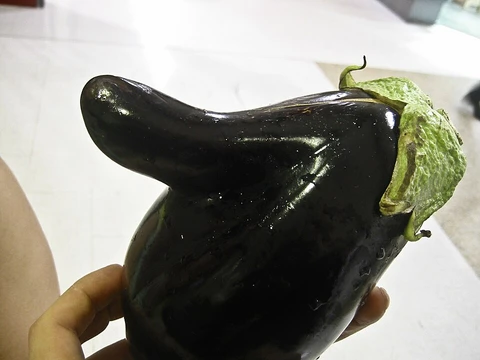
Eggplant
A nightshade berry used worldwide as a vegetable.

Solanum melongena, commonly known as eggplant, aubergine, or brinjal, is a plant species in the nightshade family Solanaceae. Grown worldwide for its edible fruit, typically used as a vegetable in cooking, it is a berry by botanical definition and is related to the tomato, chili pepper, and potato, though those are of the Americas while the eggplant is of Eurasia.
Lore & Background
The eggplant is a delicate, tropical perennial often cultivated as an annual in temperate climates. The fruit, botanically a berry, contains numerous small, edible seeds that taste bitter due to solanine and other glycoalkaloids. Common cultivars are egg-shaped, glossy, and purple with white flesh, though some are white and longer. Wild fruits measure less than 3 cm in diameter. The flesh turns brown when exposed to air.
Reader's Guide
Eggplant is nutritionally low in macronutrients and micronutrients, but its ability to absorb oils and flavors through cooking makes it valuable in many cuisines. It was originally domesticated from the wild nightshade Solanum incanum, with independent domestications in South Asia and East Asia. The plant has a profusion of English names: 'eggplant' (from white cultivars resembling hen's eggs), 'aubergine' (from Arabic via French), and 'brinjal' (from Portuguese via Indian English). Its history includes cultivation in southern and eastern Asia since prehistory, with the earliest known mention in a 59 BCE Chinese poem. It reached Europe through the Iberian Peninsula in the 8th century, becoming a staple among Muslim and Jewish communities, but remained obscure in other European regions until the 17th century.
Did You Know?
- The eggplant genome has 12 pairs of chromosomes (2n=24).
- The Italian name melanzana was adapted by folk etymology to mela insana ('mad apple'), leading to a tradition that eggplants could cause insanity.
Botanical Kinship & Culinary Versatility
Solanum melongena belongs to the nightshade family and occupies a fascinating position within the genus Solanum. While its closest relatives—the tomato, chili pepper, and potato—hail from the Americas, the eggplant traces its roots to Eurasia, making it a botanical cousin separated by both geography and history. Botanically speaking, the fruit is classified as a berry, a designation that surprises many who picture it as a vegetable in the kitchen. Its skin and numerous small seeds are both edible, though the seeds carry a bitter note from nicotinoid alkaloids, the same compounds found in tobacco. In the kitchen, the fruit's nutritional profile is modest in both macronutrients and micronutrients, yet its spongy, absorbent flesh becomes a canvas for oils, sauces, and spices during cooking. This capacity to soak up and carry flavor is what elevates it across so many culinary traditions. One practical quirk: the flesh oxidizes quickly, turning brown the moment it meets air, which is why it is almost always prepared and served cooked rather than raw.
From Wild Nightshade to Global Staple
The eggplant did not appear fully formed in human kitchens. It was domesticated from a wild nightshade species known as thorn or bitter apple (Solanum incanum), and the evidence points to at least two independent domestication events—one in South Asia and another in East Asia. This dual origin helps explain the remarkable diversity of cultivars seen today, ranging from the small wild-type fruits under 3 cm in diameter to the large, glossy, egg-shaped purple varieties that dominate modern markets. In temperate regions the plant is typically grown as a tender or half-hardy annual, though in its native tropical environments it behaves as a perennial. Two nations, China and India, account for a staggering 85 percent of that total, underscoring how deeply the crop is woven into the agricultural and dietary fabric of South and East Asia.
A Name That Traveled the World
Few foods carry a more convoluted naming genealogy than the eggplant. British and Irish English, by contrast, use aubergine, a term that arrived in the late eighteenth century via French. That French word descended from the Spanish alberenjena, which in turn came from the Arabic al-bāḏinjān. That Arabic word, however, was not native to the Middle East; it was borrowed from Persian bādingān, which traced back to Sanskrit vātiṅ-gaṇa, ultimately rooted in Dravidian languages of southern India. The Sanskrit name literally meant the class that removes wind-disorder, reflecting an ancient belief that the fruit cured flatulence. Portuguese colonial expansion carried the form bringella into Indian, Malaysian, and South African English as brinjal by the seventeenth century. The lexicographer Hobson-Jobson observed that no other word of its kind had undergone such extraordinary variety of modifications while retaining the same meaning.
The Plant in Its Physical Form
Solanum melongena is a delicate tropical perennial whose stem is frequently spiny. The flowers, which appear in shades from white to deep purple, display a five-lobed corolla surrounding bright yellow stamens. The most familiar cultivars produce glossy, egg-shaped fruits with deep purple skin and pale white flesh of a spongy, almost meaty texture, though other varieties are white and more elongated. Inside the fruit, numerous small, soft seeds are packed throughout the flesh. Genetically, the species carries 12 chromosomes. The plant's overall architecture—its spiny stems, broad lobed foliage, and showy blossoms—marks it as a distinctly tropical species, one that requires careful seasonal management in cooler climates to complete its fruiting cycle.
Frequently Asked Questions
Who is Eggplant?
Eggplant (Solanum melongena) is a nightshade-family plant cultivated across the globe for its edible fruit. Depending on the region you're in, you might also hear it called aubergine or brinjal, and botanically it counts as a berry even though most kitchens treat it as a vegetable.
What are Eggplant's powers or role in the kitchen?
Its spongy, flavor-absorbing flesh lets it shine whether grilled, fried, roasted, or stuffed, making it a staple in dishes like ratatouille, baba ganoush, and countless Asian curries. In short, it's the chameleon of the vegetable garden—taking on whatever sauce or spice you throw at it.
How does Eggplant's story end?
Grown as an annual, the plant fruits over a warm season and is typically finished off by the first hard frost. A single healthy plant can keep producing multiple fruits from midsummer well into autumn, so the 'ending' is really just the end of the growing window.
Who are Eggplant's close relatives?
It shares the nightshade family (Solanaceae) with the tomato, chili pepper, and potato. The key distinction is geography: those relatives are native to the Americas, whereas Eggplant traces its origins back to Eurasia.
More in Fruits And Vegetables 1-22
Spotted an error? Know more?
This is a living reference — every entry is fact-audited, and reader corrections feed straight into our audit queue. Suggest an edit · See this site's audit record